

All posts by Alice

Mike’s experience in the technology industry is quite extensive. During his career, he has had the good fortune of serving both as a designer of complex enterprise applications and as a corporate executive. After a career in Austin-San Antonio as an award-winning software developer for over twenty-five years, mike lives in Port Aransas managing Texas Beach Homes with a license to practice real estate in the state of Texas and a digital marketing e-Pro specialization from the National Association of Realtors. Formerly the founder/CEO of AssetWorks and USAF Officer for the New Technology Division Electronic Security Command with a graduate degree in computer science from Ohio State University.

GLO Texas Coast Master Plan

GLO Texas Coast Master Plan Covers 367-Miles

A statewide plan to protect and promote a vibrant and resilient Texas coast that supports and sustains a strong economy and healthy environment for all who live, work, play or otherwise benefit from the natural resources and infrastructure along the Texas coast.

See the Texas GLO Coastal Resiliency Plan Presentation

About 6.5 million people with total wages topping $37 billion reside along the Texas coast, as do bustling ports, military installations, 25 percent of the nation’s refining capacity, and most of the nation’s strategic petroleum reserve. Unfortunately, coastal businesses and homes are vulnerable to hurricanes and floods, and its Gulf shoreline is eroding at an average of two feet per year.

Read the Texas coast’s economic and environmental significance in “Shoring up our Future” by the Texas GLO

From the mouth of the Rio Grande River to the Sabine River, the Texas shoreline is ecologically diverse and biologically productive. Its habitats maintain native plant and animal populations, provide nurseries, nesting and foraging areas for fish and wildlife, and reduce the impacts of coastal hazards.

The Texas coast region plays a key role in the country’s energy security, with Texas leading the nation in energy production, from crude oil and natural gas. Other critical state and national economic generators along the Texas coast include waterborne commerce, military transportation, chemical manufacturing, commercial fishing, recreation, and tourism.

At any given time, there’s over two billion dollars of residential real estate for sale on the Texas coast supporting the Texas tourism industry through second home vacation rentals and local property taxes.

‘The Texas coast, however, is vulnerable to an array of coastal hazards, such as coastal erosion, sea level rise, coastal storm surge, habitat loss and degradation, water quality degradation, and other issues that are putting the environmental and economic health of the coast at risk. In addition, events within the past decade, such as Hurricane Ike and Hurricane Dolly, caused further environmental and economic devastation along the Texas coast and highlighted the urgency for better protection.

As Commissioner of the Texas General Land Office (GLO), George P. Bush recognizes the need for a plan to address the Issues of Concern that negatively impact the coast and to ensure that the state’s coastal communities become more resilient. To support the GLO’s mission to preserve and enhance the state’s coastal natural resources while promoting economic growth, Commissioner Bush directed the development of a Texas Coastal Resiliency Master Plan (Plan).
The Plan is founded on the principle of creating resilient coastal communities – the ability of coastal resources and infrastructure to withstand and rebound from natural and human-induced disturbances. Achieving coastal resiliency will reduce the state’s vulnerability to coastal hazards and protect the state’s coastal assets and environments.

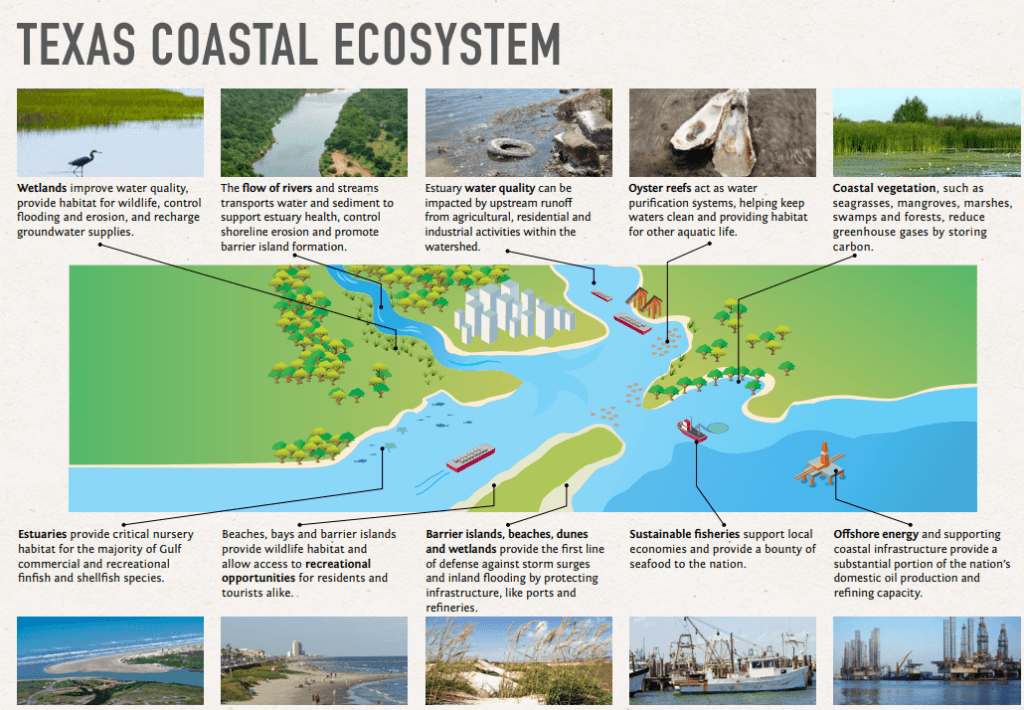
The Texas Coastal Resiliency Master Plan is working to protect residents and the economy by safeguarding the coast through marine debris clean up and the restoration of dunes, beaches, wetlands, and oyster reefs.

  • Reduce shoreline and dune erosion with renourishment efforts that get sand from dredging the intracoastal waterway and nearby rivers. Dune systems provide the first line of defense from chronic coastal flooding. These projects benefit local wildlife and protect wetlands from saltwater inundation.
  • Stabilizing the Texas Gulf Intracoastal Waterway and strengthening protective barriers surrounding shipping channels to protect industries and densely populated neighborhoods.

Barrier Islands and Peninsulas

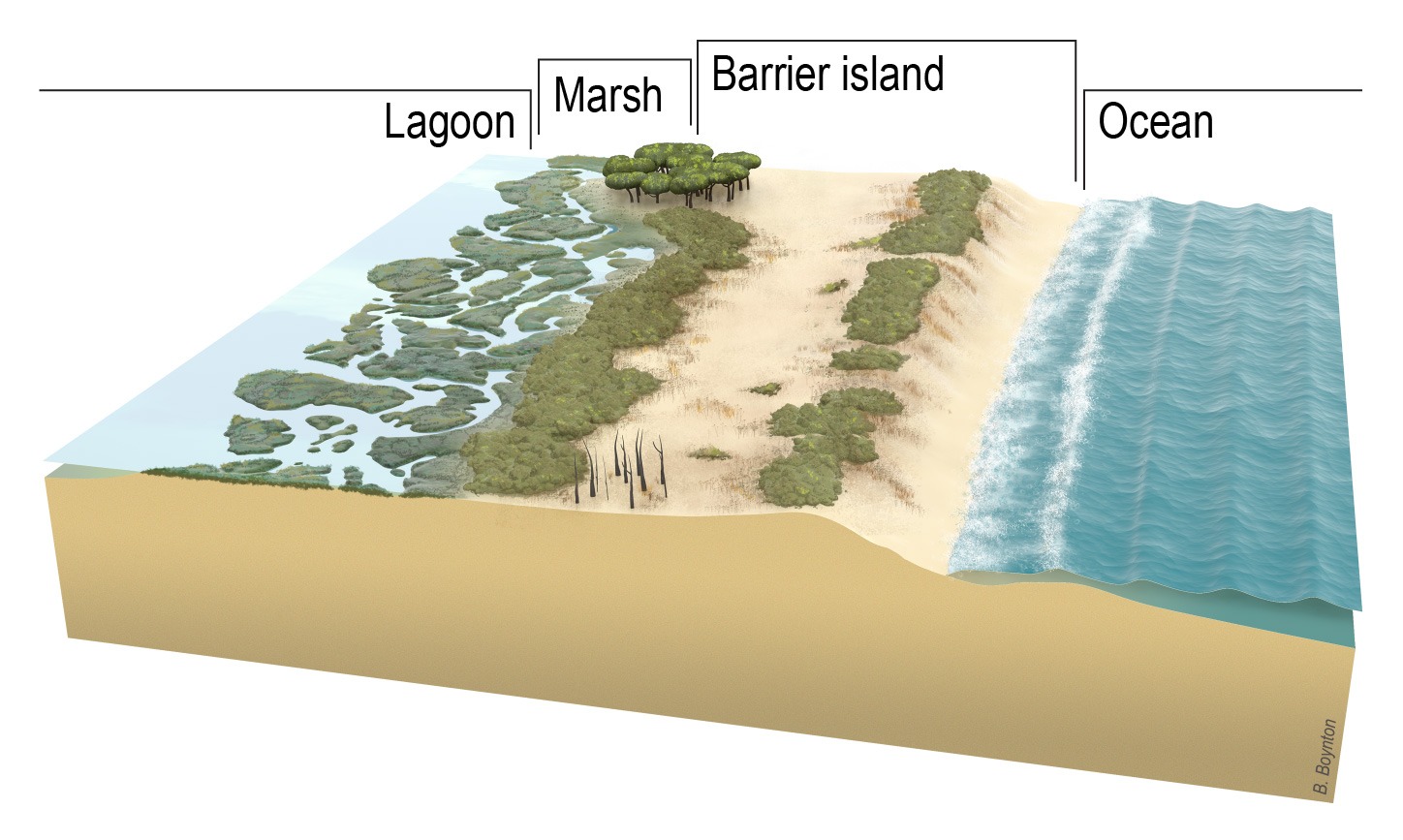
Along most of the Texas coast, there is a near-continuous chain of peninsulas and barrier islands that divides the bays and estuaries from the Gulf of Mexico. Barrier islands are long, narrow offshore deposits of sand and sediment that run parallel to the mainland along the coast, whereas peninsulas also run parallel to the mainland, but are still connected to the mainland. Shallow bays or lagoons divide barrier islands and peninsulas from the mainland. Barrier islands and peninsulas are characterized by a Gulf-facing beach and dune system that gradually slopes down to the interior bayside shoreline, supporting various habitats such as wetlands and tidal flats. The Texas Gulf shoreline has two peninsulas and six barrier islands, including Padre Island, the longest undeveloped barrier island in the world.

More Information: Texas Coastal Resiliency Master Plan

Partners: Texas Coastal Management Program, Texas General Land Office, U.S. Department of Housing and Urban Development

Comments Off on GLO Texas Coast Master Plan

Galveston Port Bolivar Ferry

One of the two Texas Coast’s Highway Ferry systems

The Galveston-Port Bolivar ferry takes travelers between Galveston Island and the Bolivar Peninsula. The Galveston-Port Bolivar ferry is the bridge between two segments of State Highway 87. South of IH-10, State Highway 87 is the only highway around Galveston Bay.

Galveston directions: 1000 Ferry Road North, Galveston, TX 77550
Bolivar directions: 123 Texas Highway 87, Port Bolivar, TX 77650

The free ferry service provided by TxDOT is the only way motorists can cross the waterway between Bolivar Peninsula and Galveston Island.

  • The 2.7-mile trip takes approximately 18 minutes to cross one of the busiest waterways in the world. Through the Bolivar Roads Channel flows the commerce of the Port of Houston, the nation’s largest inland port, as well as other Galveston and Trinity Bay communities. Approximately 7,000 ships visit the Port of Houston each year.
  • The ferry operation consists of five boats, each of which can carry approximately seventy vehicles, five hundred passengers and six crew members. Each ferry can carry eight 18-wheel trucks weighing 80,000 pounds each. All the boats are double ended with a pilothouse on each end, and the captain changes from one pilothouse to the other to go in the opposite direction.

Vehicles should not exceed 80,000 pounds, may have a maximum length of 65 feet, a maximum height of 13.5 feet and a maximum width of 8.5 feet.

Day schedule

One vessel is in operation 24 hours per day. A second vessel will be placed in service at 6:30 a.m. After this departure, the two vessels will operate based on traffic volumes, and will space themselves to carry traffic as efficiently and safely as possible. A third vessel will be placed in service during the afternoon period if necessary. Up to five vessels may be operated for summer and holiday traffic.

Night schedule

Departs Galveston Departs Bolivar
No. 1 Ferry No. 2 Ferry No. 1 Ferry No. 2 Ferry
12 a.m. 12:30 a.m.
1 a.m. 1:30 a.m.
2 a.m. 2:20 a.m.
3:05 a.m. 3:30 a.m.
4 a.m. 4:20 a.m.
5 a.m. 5:30 a.m.
6 a.m.  6:30 a.m. 6:30 a.m.  7 a.m.
Comments Off on Galveston Port Bolivar Ferry

The History of Padre Island

The Longest Stretch of Undeveloped Barrier Island in the World

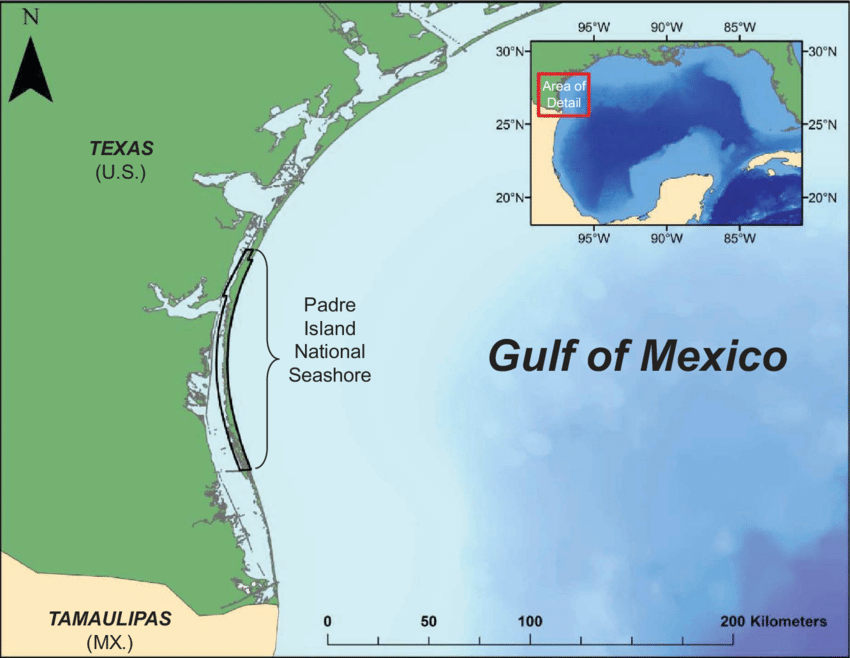
Padre Island National Seashore separates the Gulf of Mexico from the Laguna Madre, one of a few hypersaline lagoons in the world.  The park protects 66 miles of coastline, dunes, prairies, and wind tidal flats teeming with life.  It is a safe nesting ground for the Kemp’s ridley sea turtle and a haven for over 380 bird species.

Padre Island, a long sand-barrier island extending some 130 miles along the coast of South Texas, has the longest sand beach in the United States. The north end is just east of Corpus Christi (at 27°37′ N, 97°14′ W), and the south end is opposite Port Isabel (at 26°05′ N, 97°08′ W).

The Padre Island National Seashore campgrounds are open year-round. No reservations are accepted, as camping is first-come, first-served. Campers, including beach campers, must have a camping permit, which is available from the kiosks at the entrances of each campground.

  • There are no RV hook-ups anywhere in the park, but an RV dump station and a water filling station are available for all campers staying in the park.
  • Check out time for Malaquite Campground and Bird Island Basin is 12:00 noon.
  • Ice is available from 9:00 a.m. until 5:00 p.m.

The island is separated from the mainland by the Laguna Madre and connected to the mainland at each end by causeways. It is divided by the dredged Port Mansfield Channel, which provides shipping access to the Gulf Intracoastal Waterway and to Port Mansfield from the Gulf of Mexico.

Nowhere is the island more than three miles wide. The island was formed by the slow, ongoing process of sea erosion and deposition.

A large variety of shells have been washed ashore on the island, and other objects from rivers and from the Gulf have been deposited in fine silt and sand on the island. The result is a treasure hunter’s paradise.

  • The Sigsbee Deep, the deepest part of the Gulf of Mexico, is situated off the central part of the island.
  • More than 272 varieties of saltwater fish have been identified in the Sigsbee Deep, a favorite site for fishermen.
  • The island has been known by various names: Isla de San Carlos de las Malaguitas, Isla Corpus Christi, Isla del Padre Ballí, Ysla del Vallín, Isla de Bayán (Vallín and Bayán are variations of Ballí), and Isla de Santiago.
  • Indians of the Archaic period are believed to have lived on the island from 2700 to 1000 B.C. They were followed by Karankawan and Coahuiltecan peoples who visited the island seasonally until the mid-1800s.
  • In 1554 four ships sailed from Veracruz for Spain. They encountered storms, and three of the four were cast up on Padre Island at about the location of the present Mansfield Channel.

Padre Island is a biological wonder with more than six hundred species of plants and wildflowers. A unique species of oily live oak tree (Quercus fusiformis) grows only on the island. Blacktail jackrabbits, ground squirrels, kangaroo rats, coyotes, and eastern moles are among the many animals on Padre.

The Laguna Madre is noted for its astronomical numbers of waterfowl. Herons, ibis, egrets, spoonbills, pelicans, cormorants, ducks, and geese use the island and the lagoons as a sanctuary and breeding ground. In 1991 the island was divided into three distinct areas: north, central, and south.


More than 380 species of birds have been found at Padre Island National Seashore. This is half of all bird species that have been documented in North America!

The national seashore is a fabulous place for birds and bird-lovers because it is located on the Central Flyway, a major migration route on which birds travel during their migration to and from North, Central, and South America. Sandhill cranes, snow geese, redhead ducks, and several other birds fly down from northern nesting habitats to spend the winter in the area.

While visiting Padre Island, you may catch a glimpse of the Black Skimmer grazing the water with its bill, a White-tailed Hawk keeping watch, perched on top of a telephone pole, or hear the song of an Eastern Meadowlark happily celebrating the spring.

The National Seashore protects a variety of habitats that are critical to the health of myriad bird populations. Some habitats, like wind-tidal flats, are extremely fragile and rare, and provide an abundance of food upon which migratory and resident birds depend. Other bird habitats found in the park include beaches, coastal prairies, dunes, grasslands, wetlands, and ponds.

Its range of habitats makes Padre Island an essential stop-over point for migrating and resident birds that are seeking out grounds for rest, food, nesting, and breeding.

The island has been designated as a Globally Important Bird Area by the American Bird Conservancy and a Site of International Importance by the Western Hemisphere Shorebird Reserve Network.

Within the park, there are sixteen threatened and endangered bird species, making Padre Island National Seashore an even more important location to these creatures’ fragile existence. Based on the Texas Colonial Waterbird Survey, bird counts show decreasing numbers of waterbird species on the spoil islands within the park’s boundaries, but participants in the waterbird survey provide varied explanations to suggest why the decrease is occurring. Explanations include habitat loss, disappearance of nesting grounds, marine debris, depletion of food sources, windmills impeding flight, and light pollution affecting migratory patterns.


Padre Island National Seashore is a national park located just outside of Corpus Christi that includes about seventy miles of undeveloped beaches and natural habitat. South Padre Island is a resort community located near Brownsville with numerous hotels, clubs, and souvenir shops. The two destinations are at opposite ends of the long, barrier island named Padre Island and are about one hundred miles apart.

  • The park is located just south of North Padre Island. An artificial waterway, Mansfield Channel, cuts through Padre Island at the southern end of the national park.
  • The only way to drive from North Padre Island to South Padre Island is by driving inland, down Highway 77, and back out to the south end of the island –a driving trip of 3-4 hours.
  • GPS will NOT take you to the park but getting to the park is easy, Park Road 22 dead ends into the national park.

References

Comments Off on The History of Padre Island

Working With a Real Estate Agent in Texas

Working With a Real Estate Agent in Texas

A good agent should be familiar with local market conditions and prices to help you find a home that meets your budget and needs. Your agent will help you every step of the way, from preparing your written offer to negotiating with the seller on price and other key terms to coordinating the escrow process and closing.

Your real estate agent should also help you locate other professionals to assist you in the home-buying process, including mortgage brokers and home inspectors.

Luckily, working with a buyer’s real estate agent won’t cost you anything. The seller usually pays the entire real estate commission (typically 5% to 6% of the house sale price, split between the seller’s agent and yours).

Personal referrals are usually the best way to select a real estate agent. Be sure the agent you choose has plenty of experience and an excellent reputation and references.

Texas is a non-disclosure state which requires a broker-client relationship and that they show you the Information About Brokerage Services document before they can share actual sales information online or talk about subjects relevant to a property purchase.

What Texas Sellers Must Disclose to You About the Property

State law requires sellers of real estate to make several disclosures regarding the condition of the property, using the Texas Real Estate Commission’s seller disclosure form. This is important for you, since just looking at a property might not be enough to tell you what problems its owner encountered with it while living there.

The form requires the seller to list various features and types of equipment contained in the home and to state whether any known defects exist. See Considerations Before Selling a House in Texas for details on seller disclosures.

Buyers should not rely solely on the seller’s disclosure, however. The seller need divulge only what he or she knows, and that might not extend to hidden parts of the house. Plus, homeowners often become blind to home defects, having lived with them for so long. It’s wise to hire an independent home inspector and make your purchase offer contingent upon being satisfied with the resulting inspection report.

Real Estate Purchase Agreements in Texas

A real estate contract must be in writing and signed by both parties (buyers and sellers). It must contain an offer to sell or purchase, an acceptance of the offer, the sale price, and an adequate description of the property.

Texas real estate agents must use a real estate contract form approved by the Texas Real Estate Commission.

Title Issues in Texas

Your loan mortgage company will require you to purchase title insurance. Its purpose is to protect your title to the property against adverse claims by third parties or any clouds on the title missed by the preliminary title search (done before the policy is issued).

The title company will search public records and other sources for any liens, easements (such as the utility company’s right to access part of the property), or other encumbrances or restrictions that could affect your ownership or use of the property. If the title search locates problems, insist that the seller correct these as a condition to closing.

Working With a Lawyer in Texas

Unlike some states, Texas does not require that buyers involve a lawyer in the house-buying transaction. Even if it’s not required, you might decide to engage a lawyer at some point in the process for example, if you are buying property in a planned unit development with extensive CC&Rs that you need help reviewing, or if you are purchasing a house jointly with others and need help structuring your co-buyer agreement. Or you might want a lawyer’s help if disputes develop during escrow or the house closing.

Comments Off on Working With a Real Estate Agent in Texas

USGS What is a barrier island?

USGS What is a barrier island?

The United States Geological Survey (USGS), formerly simply known as the Geological Survey, is a scientific agency of the United States government. The scientists of the USGS study the landscape of the United States, its natural resources, and the natural hazards that threaten it.

Barrier islands are long, narrow offshore landforms that run parallel to the mainland coast. They are composed of sand, sediment, and other materials and are separated from the mainland by a body of water such as a lagoon, bay, or estuary. Barrier islands serve as protective barriers for the mainland against the impacts of waves, storms, and erosion. They also provide habitats for a variety of plants and animals and often support human activities such as tourism and recreation.

A barrier island is a constantly changing deposit of sand that forms parallel to the coast.

Barrier islands form as waves repeatedly deposit sediment parallel to the shoreline. As wind and waves shift according to weather patterns and local geographic features, these islands constantly move, erode, and grow. They can even disappear entirely.

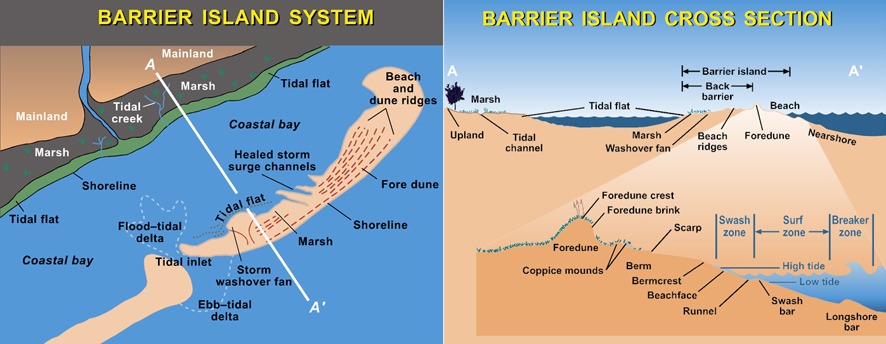
They are separated from the mainland by tidal creeks, bays, and lagoons. Beaches and sand dune systems form on the side of the island facing the ocean; the side facing the shore often contains marshes, tidal flats, and maritime forests. These areas are important habitats for seabirds, fish and shellfish, and nesting sea turtles.

Barrier islands are critical to protecting coastal communities and ecosystems from extreme weather. Beach dunes and grasses on barrier islands absorb wave energy before the wave hits the mainland. This means smaller storm surge and less flooding on the coast.  Many barrier islands are found off the U.S. Gulf and East coasts. Barrier island chains tend to form near river deltas and in areas with low tectonic activity and flat coastal terrain.


Texas Barrier Islands

The barrier islands off the Texas gulf coast host the state’s three beach resort areas with five towns, providing each Texas metro with easy access to a beach.

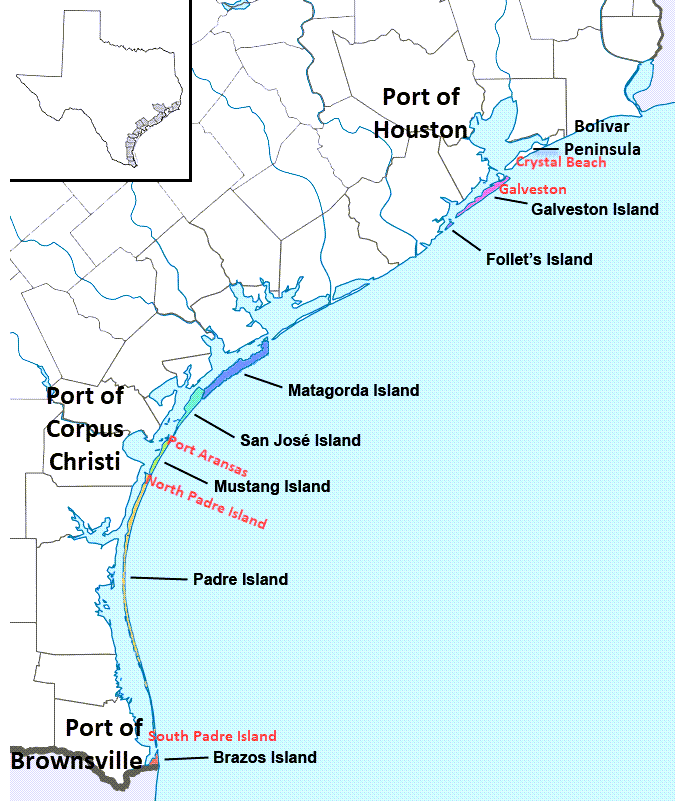
  • The barrier islands (see map) with “beach resorts” are Galveston Island, Mustang Island, and Padre Island,
  • And the Bolivar Penninsula that is “almost” an Island 🙂

Texas’ barrier islands each have a similar layout (click to view), and they also act like a shield for the state’s major ports which serve the entire nation and the world with international trade and energy exports / imports.

  • The beach resort areas host vibrant second-home vacation resort cities that the Texas metro residents enjoy.
  • In this way, the Texas coast energies both Texans and the world!

Texas “ports with resorts” – barrier islands with second homes and tourism that are in front of international ports used for energy exports and imports.

Port of Houston

Port of Corpus Christi

Port of Brownsville

Read about the value of ports to the nation

See map of major ports


Barrier Island Erosion and Climate Change

Erosion can be caused by human activities such as ship traffic, hard levees, and infrastructure projects, even those far upriver. The effects of climate change, including rapid sea level rise and extreme weather events, can cause or worsen barrier island erosion.

The U.S. Geological Survey (USGS) and the National Oceanic Atmospheric Administration (NOAA) work together, along with each state, to protect and renourish the barrier islands.

USGS and the NOAA support natural and nature-based infrastructure projects that restore and protect barrier islands and the benefits they provide to coastal communities and ecosystems. Thousands of acres of barrier islands and marshland have been restored or enhanced as part of the Gulf Restoration projects.

More Coastal Information by the USGS

Comments Off on USGS What is a barrier island?

Property Management Services on the Texas Coast

Typical Property Management Services on the Texas Coast

Market the property for vacation rentals or long-term tenants

  • Prepare home for each rental
  • Check-in and check-out procedures
  • Clean home and optimize interior appeal
  • Manicure landscaping to increase curb appeal
  • Create ads tailored to the property and advertising medium
  • Advertising mediums include:

Work with other agents to find renters and tenants

  • Provide a 24-hour hot-line for prospective tenants about the property
  • Handle calls from prospects for questions and viewings
  • Provide prospective tenants with applications that are legally compliant with fair housing laws
  • Collection applications, tenant screening and selection
  • Perform a background check to verify identity, income, credit history, rental history, etc.
  • Grade prospective tenants according to pre-defined criteria

Financial and Legal 

  • Provide accounting property management services
  • Make payments on behalf of the owner for mortgage, insurance, HOA dues, etc.
  • Detailed documentation of expenses via invoices and receipts
  • Maintain all historical records (paid invoices, leases, inspection reports, warranties, etc.)
  • Provide annual reporting, structured for tax purposes as well as required tax documents including a 1099 form, and advise owner on relevant tax deductions related to their rental property
  • Provide easy to read monthly cash-flow statements which offer a detailed breakdown of income and itemized expenses
  • Advise in the event of a legal dispute or litigation, and refer owner to a qualified attorney when necessary
  • Understand and abide by the latest local and state laws that apply to renting and maintaining rental properties
  • Perform periodic inspections on a predefined schedule looking for repair needs, safety hazards, code violations, lease violations, etc.
  • Send owner periodic reports on the condition of the property

Maintenance, Repairs, and Remodeling

  • Provide and oversee an in-house maintenance crew
  • Establish a preventative maintenance policy to identify and deal with repair needs
  • Provide a network of licensed, bonded and fully insured contractors vetted for price and work that is up to code
  • Assign jobs to different parties (employees, handyman and contractors) based on value.
  • Maintain outdoor areas
    • Landscaping
    • Removing trash and debris
  • Maintain and monitor a 24-hour emergency repair hot-line
  • Larger renovation or rehab projects
    • Provide recommendations on how the project can maximize rental income.
    • Prepare preliminary cost estimates
    • Get multiple independent bids for the work
    • Act as general contractor overseeing the work

For long term rentals

Tenant Move In

  • Draw up leasing agreement, and confirm move in date with tenant
  • Review lease guidelines with tenant regarding things like rental payment terms and required property maintenance
  • Ensure all agreements have been properly executed
  • Perform detailed move in inspection with tenant and verify condition of property prior to move-in.
  • Collect first month’s rent and security deposit
  • Rent collection, receiving rent, getting overdue payments
  • Sending out pay or quit notices, enforcing late fees, and evictions

Tenant Move Out

  • Inspect unit and fill out a report on the property’s condition when the client moves out
  • Provide tenant with a copy as well as estimated damages
  • Return the balance of the security deposit to the tenant
  • Forward any portion of the owner’s portion of the tenant deposit to the owner or hold in owner reserves for repairs.
  • Clean unit and perform and needed repairs or upgrades, and Re-key the locks
  • Put the property back on the market for rent

Want to do it yourself?


Get this book How to Set Up and Run a Successful Airbnb Business

Comments Off on Property Management Services on the Texas Coast

Ask before You Buy Insurance on the Texas Coast

Questions to Ask Your Realtor BEFORE You Buy Property Insurance on the Texas Coast

1. Is Windstorm Insurance mandatory? Do I really need it?
Mortgage companies typically require full coverage. In the event you decide to sell your home the Certificate of Compliance (WPI-8) is an excellent selling point which proves code compliance and provides eligibility for windstorm coverage.

2. If I have flood insurance, isn’t that all I need?
No. A flood policy does not cover ANY damage to a structure due to wind and hail.

3. Are all counties affected by Windstorm requirements? Is this house in a windstorm (high wind) area (First Tier County)?
Just the counties which border the Gulf of Mexico (First Tier Counties). Chambers, Jefferson, Galveston, Brazoria, Matagorda, Calhoun, Refugio, San Patricio, Aransas, Nueces, Kleberg, Kenedy, Willacy, and Cameron.

4. Is the house currently insured for wind and hail insurance?
The Certificate of Compliance (WPI-8) is “proof of eligibility” for wind and hail insurance coverage through the State’s catastrophe pool, the Texas Windstorm Insurance Association (TWIA). Homeowners may contact TDI at  www.tdi.state.tx.us for more information about the Windstorm Inspection Program or search for the Certificate online.

5. What is the claims history of this house? What repairs have been made?
The current insurance agent should have answers to all questions concerning the coverage on this structure. Including any claims filed.

6. Can I insure just the roof?
No. The entire structure must be insured to meet applicable code standards.

7. Who can conduct windstorm inspections?
An employee of TDI’s Windstorm Inspections Division, or an engineer who has been appointed by the Commissioner of Insurance.

8. What if the house does not pass inspection? What is my alternative/next step?
Completed structures can be certified by appointed engineers once deficiencies are corrected and code compliance met.


Texans living and working along the Gulf Coast should review their homeowners and commercial insurance policies prior to hurricane season to ensure they are covered against losses caused by wind and hail.

Some insurance companies provide wind and hail coverage, while others do not.

If your company has excluded wind and hail coverage from your policy, shop around. You may be able to find another company that offers wind and hail coverage in your area. If you can’t find a company providing the coverage, ask your insurance agent about purchasing insurance from the Texas Windstorm Insurance Association (TWIA). TWIA is the state’s insurer of last resort for wind and hail coverage when homeowners and business owners are denied coverage in the 14 coastal counties.

TWIA Structure Eligibility Requirements
•TWIA’s coverage territory includes Aransas, Brazoria, Calhoun, Cameron, Chambers, Galveston, Jefferson, Kenedy, Kleberg, Matagorda, Nueces, Refugio, San Patricio, and Willacy counties.

• Texas Department of Insurance (TDI) building specifications. New structures, alterations, additions, or repairs to existing structures, including re-roofs or roof repairs must be inspected by a TDI inspector or an engineer who has been appointed by the Commissioner of Insurance. There is no fee for any inspection conducted by TDI. All inspections must be made during the construction phase.

Shopping for Insurance
• Use an insurance agent to help you shop. Some agents represent only a single company or company group. Independent agents may represent several companies. To find an agent near you visit www.helpinsure.com, a free service of the state.
• Make sure your insurance agent and company are licensed.
• Use TDI’s Homeowners Insurance Price Comparisons.
• Understand homeowners policy types and coverages.
• Decide whether you need other coverages. Homeowners policies do not cover damage caused by rising waters. You can buy a separate policy to cover most types of flooding from the National Flood Insurance Program.  www.floodsmart.gov.
• Consider factors other than price. A company’s complaint history and financial rating can indicate the level of service you will receive.
• Ask about payment options and discounts, choose the highest deductible you can afford, and know how your credit score affects you.

Contact TDI for more answers to insurance questions at www.tdi.state.tx.us

Comments Off on Ask before You Buy Insurance on the Texas Coast

Like-Kind Exchanges – Real Estate Tax Tips

Like-Kind Exchanges – Real Estate Tax Tips

Like-kind exchanges — when you exchange real property used for business or held as an investment solely for other business or investment property that is the same type or “like-kind” — have long been permitted under the Internal Revenue Code.  If you make a like-kind exchange, you are not required to recognize a gain or loss under Internal Revenue Code Section 1031. If, as part of the exchange, you also receive other (not like-kind) property or money, you must recognize a gain to the extent of the other property and money received. You can’t recognize a loss.

Under the Tax Cuts and Jobs Act, Section 1031 now applies only to exchanges of real property and not to exchanges of personal or intangible property. An exchange of real property held primarily for sale still does not qualify as a like-kind exchange.

Effective January 1, 2018, exchanges of machinery, equipment, vehicles, artwork, collectibles, patents and other intellectual property and intangible business assets do not qualify for non-recognition of gain or loss as like-kind exchanges. However, certain exchanges of mutual ditch, reservoir or irrigation stock are still eligible for non-recognition of gain or loss as like-kind exchanges.

Like-Kind Property

Properties are of like kind if they’re of the same nature or character, even if they differ in grade or quality.

Real properties are of like kind, regardless of whether they’re improved or unimproved. For example, an apartment building would be like-kind to another apartment building. However, real property in the United States is not like-kind to real property outside the United States.

When multiple individuals own real property—such as when children inherit their parents’ estate or when entities like partnerships or limited liability companies (LLCs) hold the asset—problems can emerge when it comes time to sell that property.

  • If all the partners in the partnership, members in the LLC, or inheriting children agree on a common form of transaction, the complexity is removed. The entity itself either sells the real estate and everyone shares in the sales proceeds, or the entity undertakes a like-kind exchange with everyone participating in the tax deferral.
  • Problems arise when interests diverge. Some of the investing partners or inheriting children may want to cash out of the real estate, while others want to seek a tax deferral such as through a like-kind exchange.
  • Fortunately, some common transaction structures have been developed that provide a reasonable chance of yielding a predictable tax result.

The phrases “drop and swap” or “swap and drop” describe popular structures that enable real estate owned by an entity composed of several owners to engineer a like-kind exchange for some and a cash-out sale for others.

  • In brief, the partnership distributes the real property to the individuals within the entity, removing the entity-level structure and making the individuals joint tenants (the “drop”). Then partners can individually pursue the form of transaction most suitable to their interests. Some owners might sell out for cash, while others may undertake a like-kind exchange (the “swap”).
  • Drop and swap transactions are grounded in the statutory requirements for like-kind exchanges.
  • For there to be a valid like-kind exchange, real property held for qualified use (the relinquished property) is exchanged for other property of a like-kind that is held for a qualified use (the replacement property).
  • Only real property can be exchanged. Interests in the partnership owning the property do not qualify for a like-kind exchange. Thus, the real estate needs to be distributed out of the partnership to the partners.
  • For an exchange to qualify as a like-kind exchange, the investor must hold both the to-be-relinquished property and the replacement property either for productive use in a trade or business or as an investment.

Reverse Exchanges
A reverse exchange involves the investors acquiring the replacement property before the relinquished property is sold. There might be good reason for reversing the order of the transaction. The investors may want to be certain they can obtain the essential property before undertaking the large like-kind exchange.

  • The IRS has made reverse exchanges easy by creating a safe harbor.
  • If the investor falls within that safe harbor, tax consequences are predictable. For this to apply, the transaction requires that someone acquires the replacement property before exchanging it with the investor.
  • Under the safe harbor, an exchange accommodation titleholder can acquire the replacement property and hold it until the disposition of the relinquished property.
  • In a reverse exchange, the relinquished property must be identified within 45 days of transferring the replacement property, with 180 days to transfer the replacement property to the investor.

Tenants in Common Arrangements
Rather than having separate interests, an investor might want to acquire replacement property with others and contemplate acquiring an LLC interest in an entity that owns the property.

  • Since the LLC is not considered real property the investor must acquire an interest in real property, not an interest in an entity that owns the real property.
  • In this situation, the usual arrangement is for the investing group to enter a “tenants in common” (TIC) arrangement, with each investing person acquiring an undivided interest in the property.

Reporting a Like-Kind Exchange

Form 8824, Like-Kind Exchanges, is used to report a like-kind exchange. Instructions provide information on general rules and how to complete the form.


Reference:

Comments Off on Like-Kind Exchanges – Real Estate Tax Tips

Condominiums on the Texas Coast

The basics of Condominiums (Condos) on the Texas Coast

The single-family detached home with a yard isn’t everyone’s American Dream. In high-priced markets with space at a premium, the only affordable solutions for some buyers are condominiums and townhouses.

Condominiums and townhouses are forms of attached housing, homes that share common walls and communal areas with neighbors. This type of housing is popular and essential in pricey real estate markets in which only a small percentage of households can afford to purchase a home. Condominiums are beginning to proliferate in less-populated areas, too, as an alternative for retirement housing for active adults.

Condominium
Single unit, most often resembling a more superbly finished apartment. Found in complexes large and small, high-rise, or low-rise. The owner has title to the interior space of the unit and shared title to communal areas in the complex. Condominiums are governed by a condominium board of directors (voted by residents) in accordance with bylaws and covenants, conditions, and restrictions.

Town house
Two-floor unit sharing common wall with at least one other townhouse. Townhouses are commonly found in clusters (rowhouses). The owner has title to the unit and land under unit, and shared title to communal areas (if any). Some ownership arrangements more closely resemble those of condominiums. Town houses are governed by homeowner association (voted by residents) in most cases.

Know your documents
Before you buy a condominium, you’ll want to bone up on the project by yourself or with a real estate attorney. There are several documents you’ll want to go over with a fine-tooth comb before you sign any kind of purchase contract. These papers should be available from the condominium’s board of directors or their representative. They include:

Master deed: The key document in a condominium project, the master deed establishes the project as a condominium project. It gives residents the authority to form an operating association and gives the legal descriptions of all individual units and communal areas.

Bylaws: These can become sticky in heated board of directors’ discussions. Bylaws are the operating rules for the condominium association. Among other things, they authorize a budget to be created, the assessment of fees, the hiring of professional management staff and other operating duties.

House rules: These also can become sticky when owners disagree. House rules govern what owners can do in shared areas.

Covenants, conditions, and restrictions: Private restrictions on the use of project property; usually created by the developer.

Purchase agreement: This is like a standard purchase. It should include a cooling-off period during which you can back out and financing and inspection contingencies. Other papers: Current operating budget, current and proposed assessments, financial statement of the homeowner’s association and any leases, contracts, blueprints, or other design plans.

Condominiums may offer maintenance-free homeownership, but not all condominium projects are nirvana. Take the time to check out the complex before you buy and look out for these red flags: If more than 50 percent of the units are rentals, think twice about the project. Upkeep may be poor, and some lenders will not make a loan on a unit in the complex, which could reduce the long-term value of your investment.

If the condominium association doesn’t have a health reserve fund, beware. If there isn’t money to fix major items such as a new roof or plumbing, the members will be hit with a special assessment to pay the tab.

Avoid a condominium association in which the board of directors isn’t getting along. They will make poor decisions for everyone else despite one another. Avoid a condominium project that is heavily involved in litigation. Lawsuits from builders and other homeowners can put a cloud over the project.

Comments Off on Condominiums on the Texas Coast

Fractional Ownership on the Coast

Fractional Ownership is coming to the Texas Gulf Coast

What is Fractional Ownership?
Fractional Ownership is a middle ground solution to second home ownership. It is between whole ownership, with sole responsibility and full exclusive use, and time-shares, where most often, you purchase vacation time in a resort, (about two weeks) not the real estate itself. Factional Ownership consists of owning an “Undivided fractional fee-simple interest” in a specific property. In simple terms, you are buying your vacation home in partnership with other owners who share the cost with you.

Fractional vacation homes have the appeal of defraying costs by sharing them with others and making effective use of the time that you are not using the property.

How does it work?
Fractional Ownership is like any other real estate purchase, except that you are only purchasing a fraction of the property instead of the whole property. Different developments and properties have a variety of options. The fractional shares can vary from a thirteenth (1/13th) to a half share (1/2). A thirteenth share, for example, provides one week’s use of the property each season for a total of four weeks per year. If this were all that you wanted, you might want to compare the costs to a timeshare. However, more common are quarter shares, where you use the property one week out of every month, sharing the property with only three other purchasers. Under this unique form of strata title ownership, an owner has registered title to a one-quarter interest in the condominium, estate, or townhouse.

Management of the property is most often taken care of by a third party or a Homeowner’s Association. In some developments, the Homeowner’s Association leases the units from the developers, and you, as the quarter owner, sub-leases the unit back. In some cases, an annual budget is established, and owners make monthly or quarterly payments to cover utilities, insurance, taxes and the like.

Benefits
One of the main reasons people buy fractional, even when they can afford the entire purchase, is that the expense and responsibility of ownership is reduced. This makes the second home truly a vacation, as you can simply go there, and know everything is in order. At the same time, you have the deed to the property, and you can pass it down through generations in your family or resell it through a broker.

Some of the fractional developments also participate in global vacation exchange clubs. This offers the ability to travel elsewhere for vacations, while still maintaining the fractional ownership of your own property.

Many of the fractional developments are in high-end resort locations, where condominium or property ownership is priced at the high end. Again, the fractional owner has access to all the amenities in the resort area, while paying less to get in.

Some Key Advantages

  • Affordability. As an example, a one-fourth share in a four-bedroom oceanfront home goes for far less than you’d pay outright.
  • Shared costs. Taxes, maintenance, insurance, snow removal, financing costs. The agency manages these things, so you don’t have to.
  • Deeded ownership. As with all fractional, you own something that can be bought, sold, borrowed against, or transferred to your heirs.
  • Business relationship. No arguing with your in-laws about whether your mounted deer trophy can go over the fireplace, or whether they paid their share of the snow-removal costs.
  • Flexibility. You can sell whenever you want, or you can buy out your common tenants as time goes by. Shared ownership can be a wonderful way to get your foot in the door.
  • Expanded possibilities. If you’ve got more to spend, consider owning more than one share in different homes in various places.
  • You can get more than one vacation home experience for less than the price of one.
Comments Off on Fractional Ownership on the Coast